

The store is only
one part of the system.
More traffic won’t fix unclear product information. A better checkout won’t fix disconnected inventory. And a redesign won’t answer questions your reporting never measures.
Buying friction can begin in the campaign, the catalog or the delivery promise. We start with the business outcome, then find the connections that make the next change useful.
Acquisition quality → discovery → product confidence → purchase → customer experience.
Every step has
a job to do.
From the first click to the next purchase, the experience should help people move forward with confidence.
- 01
Discover
Connect campaigns, landing pages and search to the products customers expect.
- 02
Browse
Make navigation, collections, filters and merchandising work as one path.
- 03
Evaluate
Explain fit, options, imagery, reviews and the reason to choose.
- 04
Buy
Reduce mobile, cart and checkout friction. Make shipping expectations clear.
- 05
Return
Connect customer experience, email/SMS and lifecycle follow-up to the next visit.
A good catalog
needs a clear
path through it.
Merchandising is part of conversion strategy. The collection, filter and product order should reflect how customers choose—not just how the catalog is organized internally.
We shape product discovery around the questions people bring, the range available and the commercial priorities behind it.
Find the right range
Collection architecture, category navigation, search, filtering and product sorting.
Understand the options
Product hierarchy, variants, swatches and comparisons that make differences visible.
Choose the next step
Recommendations, bundles and promotion presentation with a reason to be there.
Make the choice
clear.
The PDP has to answer the practical questions behind a purchase. On mobile, that hierarchy matters even more.
- Is the product—and who it is for—easy to understand?
- Can shoppers distinguish options and select the right variant?
- Do imagery, benefits and reviews answer the questions that hold up the purchase?
WebP / Approved real screenshot
Show: desktop PDP, fabric/hardware swatches and mobile variant choice.
Crafted Gates / Shopify product pages, swatches, product presentation and reviews. Signup and welcome, browse, cart and checkout flows extend the journey beyond the PDP.
The platform
serves the plan.
Choose around product complexity, merchandising, integrations, operating needs and the team that will maintain the store. The right foundation makes improvement easier to sustain.
Shopify / Shopify Plus
New storefronts and existing-store development, theme improvements, merchandising and app integrations. Evaluate Plus against real business requirements and operating complexity.
WooCommerce
A flexible commerce foundation within WordPress. Plan the catalog, UX, checkout and integrations alongside maintenance and the infrastructure behind the store.
Platform capabilities inform the decision. They do not replace the commercial plan.
Find the friction.
Then improve
the experience.
CRO starts with a diagnosis. It is a disciplined way to improve the buying system, not a collection of disconnected experiments.
- 01
Identify friction
Read GA4, funnel and device behavior alongside session evidence, cart/checkout data and customer questions.
- 02
Prioritize opportunity
Separate a measurement gap from a buying problem. Choose the change most likely to resolve the observed constraint.
- 03
Change the experience
Improve navigation, merchandising, PDP content or checkout where the evidence points. Define what success would look like.
- 04
Measure + improve
Review product-level behavior and commercial results. Use controlled tests when volume and conditions support them; document what remains uncertain.
Commerce does not
stop at checkout.
The customer sees the storefront. The experience also depends on the product data, stock, orders and follow-up behind it.
Define how information should move, who owns it and what happens when it fails—before adding another tool.
- Promise → Availability
- Product data and inventory should support what the store offers and the channels can actually fulfill.
- Order → Fulfillment
- Connect order flows, ERP workflows and fulfillment. Make exceptions visible to the people who need to resolve them.
- Purchase → Relationship
- Signup, welcome, email/SMS and lifecycle automation should reflect customer behavior and the experience after delivery.
- Activity → Evidence
- Connect analytics and reporting so the next decision can be made from reliable commerce signals.
One business.
One commercial
direction.
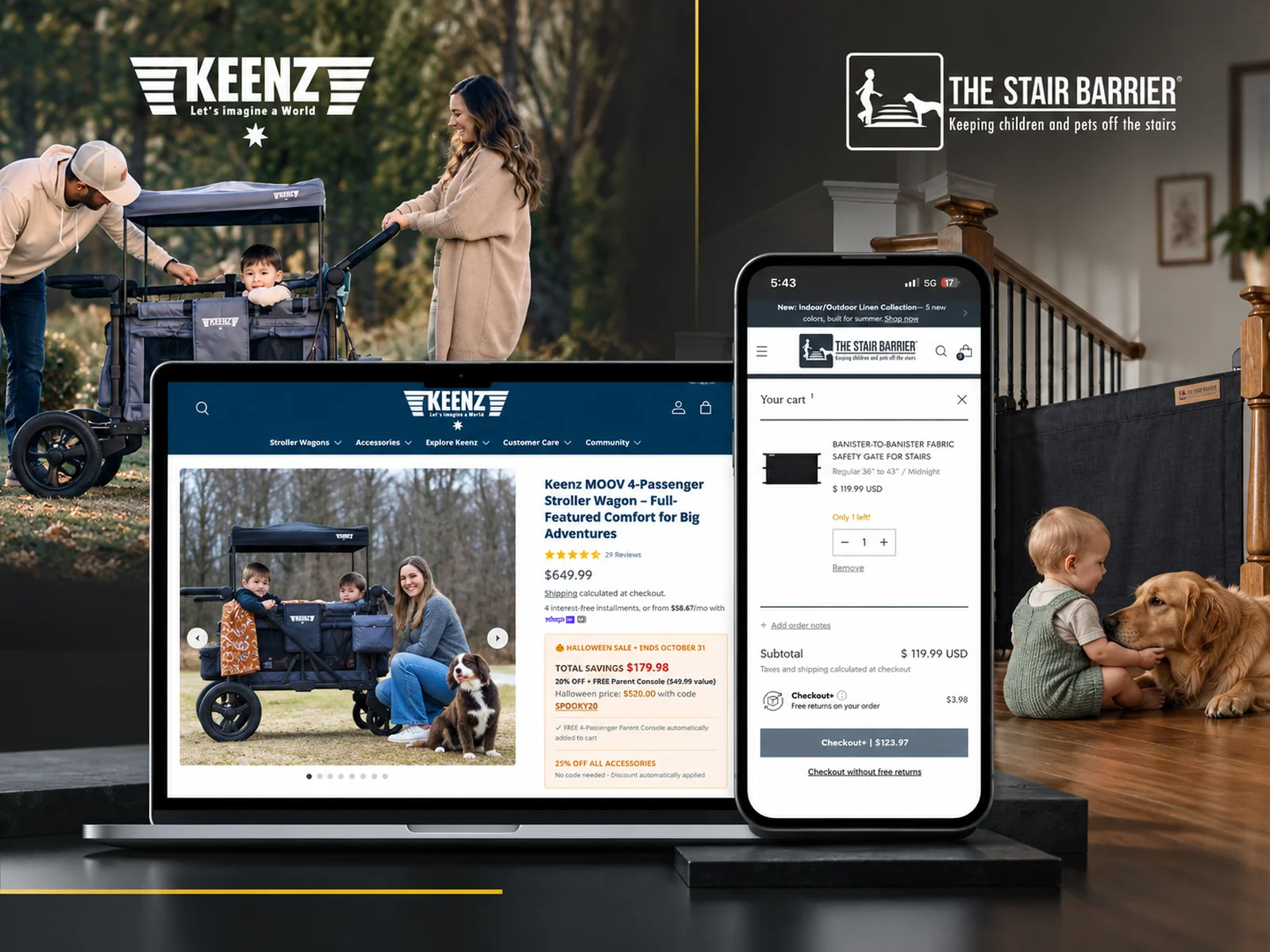
KEENZ / Connected commerce
Shopify merchandising and promotional execution sit alongside acquisition, analytics, launches and marketplace activity. A storefront change needs to make sense within that wider operation.
DTC and Amazon & Marketplaces influence assortment, pricing, inventory, content and demand. We connect those decisions rather than treating each storefront as a separate business.
WebP / Approved real screenshot
Show: one real promotion across storefront, product offer and channel context.
Give the click
somewhere useful
to go.
Paid media cannot compensate indefinitely for a weak buying experience. Relevant landing pages, clear product choices and a credible offer make acquisition more productive.
Connect Google Ads and Shopping, Meta Ads and product and campaign creative to what customers find after the click.
WebP / Approved real screenshot
Show: approved campaign/landing/PDP sequence for the same product.
The Stair Barrier / Commerce work connects with acquisition and marketplace execution. Product fit, offer presentation and the buying journey need to carry the same commercial direction.
Understand. Decide. Do. Improve.
Understand
The outcome, customer, economics and friction.
Prioritize
Decide what to change first and what needs more evidence.
Execute
Design, build and connect the work with your team.
Measure + improve
Read the results. Refine the next decision.
A few useful
questions.
Do you work with existing Shopify and WooCommerce stores?
Yes. We assess the current experience and operation, then scope improvements around the business priorities. A new platform or theme is not automatically the answer.
Do you build new stores or improve existing ones?
Both. We can move from strategy into storefront development, merchandising, integrations and optimization. The scope follows the work the business needs.
Shopify or WooCommerce—which is better for our business?
The choice depends on your catalog, customer experience, integrations, team and maintenance needs. We evaluate the requirements and tradeoffs before recommending a foundation.
Can you improve conversion without rebuilding the whole site?
Often, focused changes are worth evaluating first. We investigate discovery, PDP, mobile, cart and checkout friction to determine whether targeted optimization or a broader rebuild is appropriate.
Can you connect our store with marketplaces and other systems?
Yes. We can help plan and execute connections across product data, inventory, orders, marketplaces, analytics and lifecycle tools. Feasibility and ownership are defined around the systems already in use.
Do you handle ongoing optimization after launch?
Yes. We can continue with measurement and prioritized improvements after launch. We agree the scope and operating cadence around the business needs rather than a predefined website package.
Your store shouldn’t
be the limit.
Tell us where customers hesitate, where your systems disconnect and what the business needs to achieve. We’ll start there.